

Rating: instant classic
It was the summer of 1988 and, as my father and I walked through the Melrose Park Toys R’ Us in search of a birthday present, my mind was in other places. After all, Appetite for Destruction had recently been released, the Seoul Olympics were in their full glory and, puberty was “feeling like a space brain”. Having passed the age of GI Joe but still a few years shy of the venerable keg stand, I was in that no-man’s land of pre teen angst and gawky awkwardness. Browsing through the video game shelf my eyes settled on RBI Baseball, a new game offered by Nintendo that emerged side by side with the baseball card-collecting craze of the late eighties. To those readers between 28 and 35, RBI baseball was the quintessential home video game of your youth. Hour after mindless hour I sat tan-less and zombie eyed in my basement taking on all challengers; from the Iranian kid down the street who would serve up meatballs to George Bell, to the purists like Sean Gillis and his infernal Red Sox (it seemed Bruce Hurst could throw for 20 innings!). The summer just rolled along.
Winning more often than losing, I tried to exact the game to a science. I played it straight and never relied on the junk ball. The Tigers were my team. They had decent power hitters with Nokes, Evans, and Trammel and speed to boot. Tom Brookens was an underrated clutch replacement that would get the job done with a solid battery of pitchers backing a tough line up. When I won I wasn’t silent about it. I talked trash and humiliated my opponent. It was, after all, a test of pre-manhood.
The musical score of RBI baseball was a monotonous do do da do da do do do that may have been, along with Appetite, the unofficial anthem of my youth. The drone was only occasionally broken by the sound of a crashing home run or a well-hit foul ball. RBI baseball was my obsession. It was my north, my south, my east and my west. In my formative years I would matriculate to John Madden Football and NHL hockey of the Sega systems where I was considered a neighborhood phenom. Opponents would be blinded by my paddle speed (in NHL) and complain that I must be a paddle watcher, the “high crime” of any serious gamer, in Madden because it seemed that I always new what plays the loser to my left would be running and would crash down upon unsuspecting quarterbacks or running backs with a blitzkrieg defense that rivaled the fury of Zeus himself. If you are looking for humility you can stop now, for it has no place in the land of video games.
I drove my brother to the edge of madness, as Yzerman, Yserbart, Lidstrom and Federov became his own personal Four Horsemen of the apocalypse. Once I scored an overtime goal that infuriated him to the point of violence. What ensued in my basement was the infamous “Any which Way But Lose” fight that spanned thirty minutes and two floors in my house. It ended with a pool stick and tears; as if it could have ended any other way. I stopped playing video games in law school when I sprained my wrist punching a couch in response to an interception that I threw against a computer opponent. I had had enough. My then girlfriend and now wife had also had enough too.
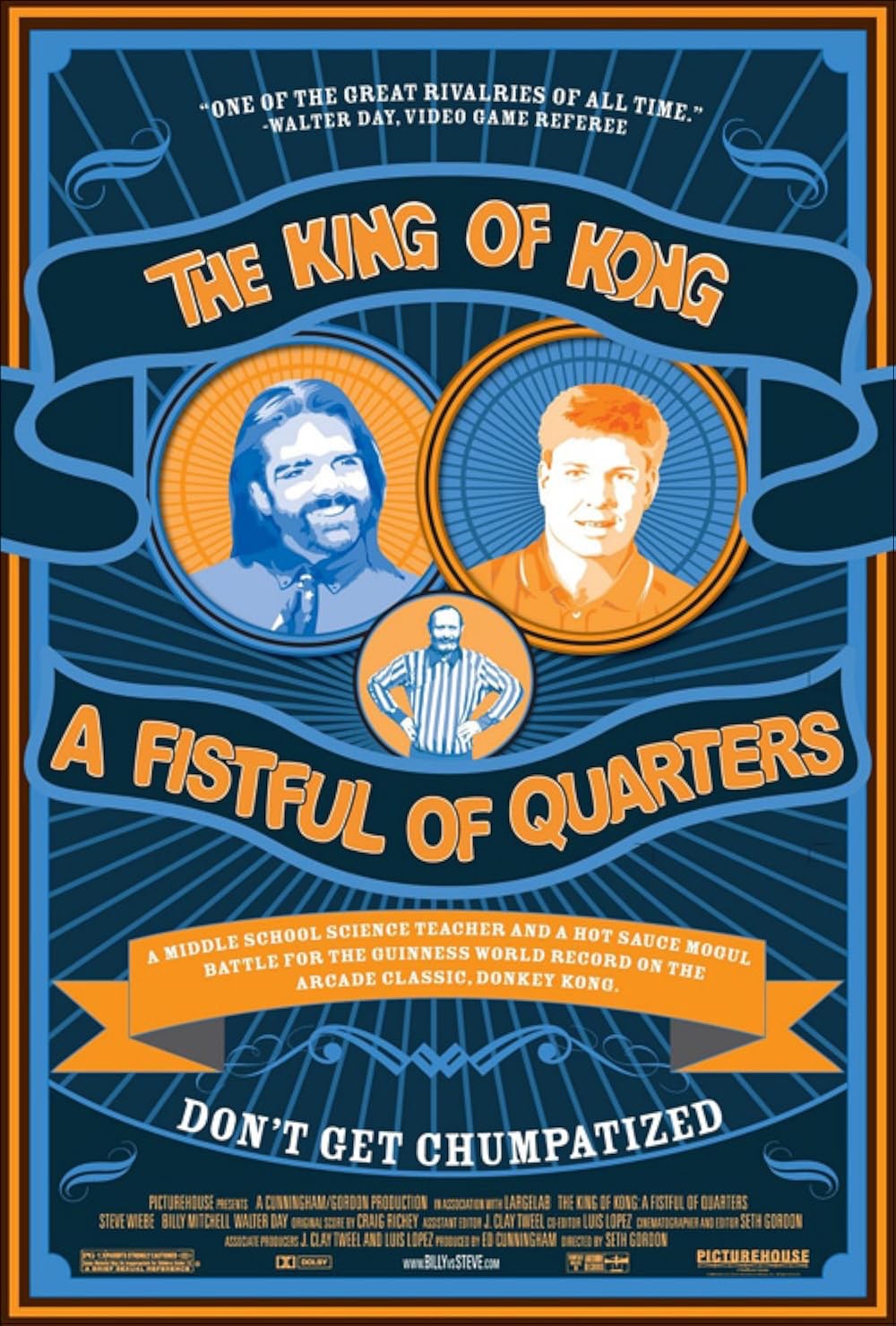
If this seems like a long preamble to a movie review you would be right. It is with this background that I watched “King of Kong, a Fistful of Quarters”; a movie about adult men who are possessed and obsessed with competitive video gaming. To say that I enjoyed this movie would be a gross understatement. K of K is a documentary that takes the viewer into the small but ravenously serious world of competitive gaming. Not real sports mind you (although the gamers themselves would most certainly disagree) but video arcade games, and, more specifically, classic video arcade games. The games of my EARLY youth: Pac Man, Frogger, Missle Command and the namesake Donkey Kong.
The movie is about, like most non-sport video games, good versus evil. The good is a man named Steve Wiebe from Seattle Washington. He is a family man who never quite excelled at anything to a point of satisfaction. He was a high school pitcher who was injured during the big game. He purchased a home with his wife and was laid off from Boeing the same day as the closing. He is a man searching for validation. The fact that he has a beautiful family and a roof over his head doesn’t seem to fulfill him in the way that securing the top score in Donkey Kong most certainly will. This movie makes us like Steve Wiebe from the get go. He is a man we can root for and is on a journey I can respect.
Enter Billy Mitchell. Mitchell is the undisputed king of video games. He is the record holder for Donkey Kong and is one of the most ridiculous villains to ever be introduced in cinema. He has a crimped mullet and a hideous 80’s style beard. He looks like a smaller, more retarded version of Randy Macho Man Savage. Mitchell learns that Wiebe is gunning for his record and he is none too happy. Mitchell is revered in that competitive gaming community and has rarely been challenged. Wiebe sets off to take the record. What unfolds is Donkey Kong’s version of cat and mouse. Will Wiebe take the record? Will Mitchell allow it to be done or will he do what needs to be done to keep his legacy secure? Will any of these guys ever get laid?
The true joy of the film is being introduced to the “competitive gaming community”. These are the type of guys that Trekkies pick on. They are such a small insular group whose only seeming drive is to play early 80’s video games and eat Dominoes pizza. The center of the gaming universe is Twin Galaxies, the group that keeps scores, referees and sanctions the competitive gaming. This movie works because it takes the material seriously and shows a true human drama unfold in a world that most of us cannot understand.
I suspect that more than one of these gamers may be registered with local sheriff’s authorities, although I have no proof and most of them probably live alone or with their mothers. They seek glory on the screen rather than on the field. They are close knit, nerdish and wonderful. The men in this movie (as you don’t see too many knock-out babes hanging out and Funzone New Hampshire) have never heard the famous passage, “When I was a child I spoke as a child, I understood as a child, I thought as a child; but when I became a man I put away childish things.” Or maybe they have and just don’t care, or maybe being obsessed with Donkey Kong is no more foolish than being obsessed with pro football or porn. In the end, though, we care about Steve Wieb and his struggle.
The final reel is Wiebe trying to unseat the evil Mitchell as the Guiness Book writers wait for the official announcement of the world record holder for Donkey Kong. Whether he does or doesn’t unseat Mitchell shouldn’t matter to the average Joe. But, by the end of this movie, it is all that matters.
On this fine summer day, as I sit at my computer, I imagine little kids playing ball in the lot down the street from my house. They are taking on the personas of their favorite players. Maybe one kid yells out “I am Derek Lee!!!” or another “Hey, I’m Jeter!!!”. I would bet that this type of coming of age make believe is happening all over the country in ballparks and in street games with barbecues to boot. And, I would also bet, that in some seedy arcade another type of hero is being emulated. As some 11 year old jumps a barrel and ducks a fireball in pursuit of separating the ever elusive Kong from his Queen, he may shout out “I’m Steve Wiebe”. And that too is fine.
DMC
